

Sometimes, there are words where everyone thinks they know what it means, and also, that everyone else also has the same idea of what it means. But then it turns out that terms like ‘fediverse’ can have surprisingly vague edges. If someone talks about the fediverse to you, it’s easy to imagine a cluster of Mastodon servers that are talking to each other, with some added Pixelfed, Misskey and Lemmy servers added on top. It’s good enough for most conversations, but there are some surprising questions that can pop up, once you start to peel at the definition. Do you include that one specific Mastodon server as part of the fediverse? Or what about this software that’s not a social network, but still has some sort of ActivityPub integration? Answers to these questions might always not be so easy.
Wikipedia’s definition provides a good start, which says: “The fediverse is a group of federated social networks that allow users of a service to communicate with users of the other services, typically using the ActivityPub protocol.”
This definition gets the idea across fairly well. However, there are multiple meanings of the word fediverse, that mainly from the boundaries of the network, and how large people imagine the network to be. Defining those boundaries might be more complicated than people expect, however. In this article I look at three different ways people can interpret the term fediverse: by focusing on either Community, ActivityPub, or Interoperability. In every interpretation there is a ‘core’ part of the fediverse that everyone agrees on that it is a part of the fediverse. The edge cases is where it gets interesting, fuzzy, and where people will disagree with each other.
One note before we start: the term fediverse has an interesting history as well, which I’m not touching upon in this piece. If this is something you’re interested in, I recommend this piece by WeDistribute.
Community
In the interpretation of fediverse as a community of connected servers, the focus is on which servers are actually connected with each other. Servers that could theoretically connect with the rest of the network, but are largely not doing so (because they are blocked by many servers, for example) are often interpreted as not being a part of the fediverse. The fediverse is seen as having a specific culture and norms, and servers who are not part of this culture are actively resisted from becoming part of the fediverse.
A clear example of this is the fedipact, where people have signed up to proactively block Threads when they implement ActivityPub. When people talk about Threads joining the fediverse being bad for community, safety or moderation, this is a prescriptive view of the fediverse, where the fediverse ought to be a group of social networking servers that share common values. Because they see Threads and Meta as not living up to those values, they push back against Threads joining the fediverse.
This view also explains some of the harsh pushback people voiced when the Stanford research on CSAM on Mastodon was released. People felt like “their” fediverse was under attack for stuff that happened on activity that was not part of their network. A post with a high engagement was fairly explicit in this, saying: “the fediverse as you know it is absolutely NOT a fucking hub of CSAM”. Even though the Stanford report found CSAM material on servers that fall within the top 10 Mastodon servers in size, these servers are perceived as being outside of the network and the fediverse.
A generalised, rough definition of this interpretation of fediverse would be ‘all ActivityPub servers, minus the servers that are on the T0 block list’. The T0 block list is the block list that gets recommended for new admins to block the worst of the worst servers (such as kiwifarms and other extremist hate group servers). This definition gives a rough general direction, but is not fully accurate, and it should be assumed that everyone has a slightly different idea of which servers to include and exclude.
ActivityPub
Another form of describing the fediverse is by focusing on the underlying protocol, ActivityPub. In this view, all platforms, servers and projects that connect with each other using ActivityPub are part of the fediverse. This is a fairly straightforward definition, and more commonly used among developers. When you are building new software for the fediverse, you are mainly interested in making sure that the communication with other fediverse software works correctly.
The focus on ActivityPub does result in stretching the definition of social networks. For example, Castopod is a podcast hosting platform. It uses ActivityPub to allow people on other ActivityPub platforms to interact (comment, like, share) with the podcasts. Castopod explicitly defines itself as part of the fediverse. When people talk about social networks, they often think of feeds that show posts of other people, whether that is in short text form (microblogging), pictures (Instagram, Pixelfed) or video (TikTok). Castopod does integrate with a social network, but the software itself is not necessarily a social network.
This means that in this understanding of the word fediverse, software can become part of a social network by integrating with the ActivityPub protocol.
Interoperability
The third approach is to focus on the interoperability that the open protocol of the fediverse allows. If you can fully interact in both ways with someone else, that means they can also be seen as part of the fediverse. For example, most people who are using Mastodon are mainly interested in being able to follow their friends, read their posts and send replies, which their friends can also read. They are less interested in whether their friend uses Friendica, Firefish or Akkoma, as long as it all just works. Earlier this year, Axbom posted a picture as an explainer of what the fediverse is, which seemed to show this position. Their visualisation showed ActivityPub as the largest ‘tree’, but also included other networks, such as diaspora* and Matrix.
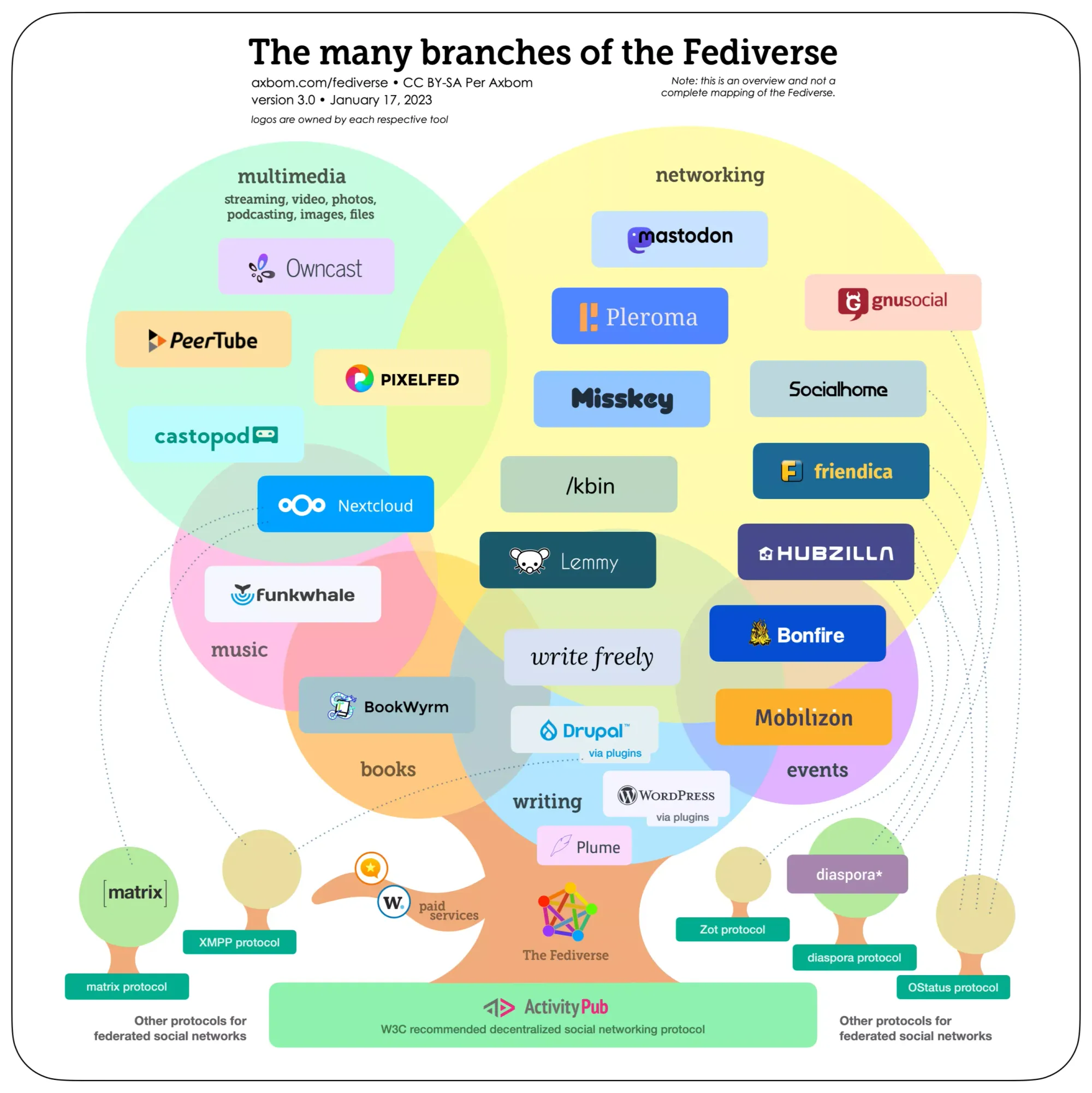
This definition overlaps with the previous one that focuses on ActivityPub, but it starts to become more diffuse at the edges. What about other decentralised protocols? Is diaspora* part of the fediverse? What about Matrix? Or even more interestingly, what about Nostr?
It turns out that this cannot be answered by only looking at interoperability, as culture again plays a large role. For that, we need to take a look at 2 software projects for social networks. Both are decentralised, and interoperate with themselves using a protocol that is not ActivityPub. Both projects allow for full communication and interoperability with the rest of the ActivityPub-based network. However, the answer to the question of whether they are part of the fediverse is drastically different.
Servers that use Hubzilla use the Zot protocol to communicate with each other. People using Hubzilla can individually decide to “turn on” ActivityPub and interact with the rest of the fediverse.
People that have an account on the Nostr network use the Nostr protocol to communicate with each other. They can automatically communicate with people on the ActivityPub network with the Mostr bridge, with no extra installation required.
On an abstract level, there is little difference between these two: in both cases it is a decentralised social networking software, that internally uses their own protocol to communicate, and can communicate with the ActivityPub network. Any work by Mike MacGirvin feels like it should automatically be part of the fediverse, considering the great amount of contributions to the fediverse he has made over the years with Friendica and Hubzilla. Hubzilla and Friendica have always been at the crossroads, of being part of multiple networks, but always also being considered part of the fediverse.
On the other hand, I have not encountered anybody who said that Nostr was part of the fediverse, and I imagine that most people from both the ActivityPub network as the Nostr network would strongly object to it. That said, the interoperability works well, following Jack Dorsey works as simple as searching for this address using your fediverse account.
Mix and Match
Overall, it seems like most people hold a fairly flexible definition of the term fediverse. The definition can differ depending on the context, and no formal definition that is consistent in all edge cases is necessary. Still, it is helpful to understand that there can be slightly different meanings of the term, and discussions can become confusing when people start arguing about ‘the fediverse’ with each other when they are using different definitions. This was especially clear during conversations about the the fedipact. A response to the fedipact that popped up multiple times is that you cannot stop Meta from joining the fediverse because ActivityPub is an open protocol. In such conversations, it is critical to examine what people exactly mean with their use of the word ‘fediverse’. It is true that you cannot stop someone from implementing ActivityPub. But as we’ve seen above, the term fediverse means more than ActivityPub support, it can often mean a specific culture as well.
Looking forward
The question about what the fediverse is, and where its boundaries are, are looking to become even more complicated into the near future. The following trends are something I am keeping my eye on:
- What will happen when Bluesky actually becomes decentralized? People are working on bridges between the different protocols. The earlier question raised about Nostr has so far not been on people’s mind much, as there is little overlap between people who use the ActivityPub social networks and those who use Nostr. There is a great deal more overlap between people on the ActivityPub network and Bluesky. Will people consider Bluesky part of the fediverse, in the situation where they could fully interact (follow/post/reply) with each other?
- Threads seem to be serious about adding ActivityPub support. Although the fedipact is popular, there is also a significant group of people who are open to federating with Threads. Will it be considered part of the fediverse if this happens?
- The ActivityPub protocol is currently mostly used for microblogging-like social networks, but the protocol does allow for other applications as well. If these were to get more popular, would this be considered part of the fediverse as well?
- Lemmy and Kbin are sometimes referred to as the threadiverse, to distinguish the link-aggregator platforms from the microblogging platforms such as Mastodon. Is this a trend that will continue, and might we even see more derived names that refer to specific subsets of the fediverse?